 earlymedical
1.4.1. Activity
Your Timeline Exercise
This exercise is meant to provide a vision of what you want so you have the motivation to do the work. The end result can be incredibly powerful and can help people remember why they make the sacrifices they do.
TIMELINE INTRODUCTION
This exercise is meant to provide vision of what you want so you have the motivation to do the work. The end result can be incredibly powerful and can help you remember why you are making the sacrifices you do.
Optimizing long-term health requires a long-term mindset and an ability to do hard things now—understanding that many benefits will come much later.
Whether or not you have a partner, kids, family, friends, or even pets, think about who you want to be spending time with and what you want to be doing in your Marginal Decade. Use the people and things that bring you joy as your anchor, the core reason for being early. We hope you enjoy this exercise.
RESOURCES
Instructions
STEP 1
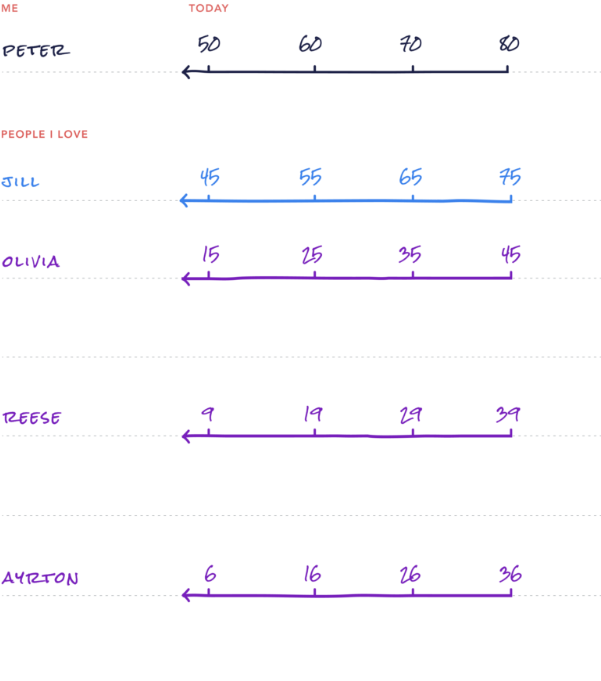
Throughout this exercise, I have included my own information as examples to illustrate the concepts, but I invite you to make this your own. Start by writing your name in the space labeled “Me.” Then, write your current age on the first dash. On each of the subsequent dashes, write the age you’ll be every 10 years, until you reach the age of average life expectancy—this is roughly 80 years for a healthy adult in the U.S. To finish, draw a line from today until 80.

STEP 2
Now, add parallel “life” lines for the people that mean the most to you. Align their present ages with your own, using a different color for each generation. In my example, I’m 50, my spouse is 45, and our kids are 15, 9, and 6. Their lines follow under mine and start at their current ages. Leave a space under each child’s name to account for future grandchildren. If you don’t have children, think about your goals for your Marginal Decade. What do you want to be doing? Who do you want to be spending time with? This might be your siblings, best friends, romantic partners, etc.
Now pause.
When I looked at my lines the first time I did this, a few things jumped out. First, was the simple observation that, at least actuarially, I’m on the downside of my lifeline—I’m past the halfway point of my expected lifespan. And second, was an awareness that living a few more years at the very end of my life, especially high-quality years, could profoundly impact my time with yet-to-be-born grandchildren.
Stop for a moment, be still, and think.
Really reflect on what these lines mean for you.
This is a bit morbid, contemplating the end, but it’s an exercise many faith and philosophical traditions have long practiced. If you don’t do anything to proactively optimize your lifespan and healthspan, this is your future (if you’re lucky). That is, if you are even fortunate enough to live to the average expected age—roughly half of people don’t, after all. And that says nothing of your healthspan in those final years. But we are not here to be average.
STEP 3
With a dotted line, add one more decade of life to your row.
Then add one more decade of life to everyone else on your page. There’s no guarantee that this will happen, but how would things change in your Marginal Decade if it did? It would be a major understatement to say that this version of the chart is a reason to get excited. Think about the implications of that extra 10 to 20 years: the life events you will experience, the people you will get to meet, and the wisdom you will get to share. And if we do this right, those extra years will be spent in good health.
In my example, adding a decade to everyone’s timeline means that I’ll be able to see my youngest grandchild when he/she is 15 years old instead of 5.
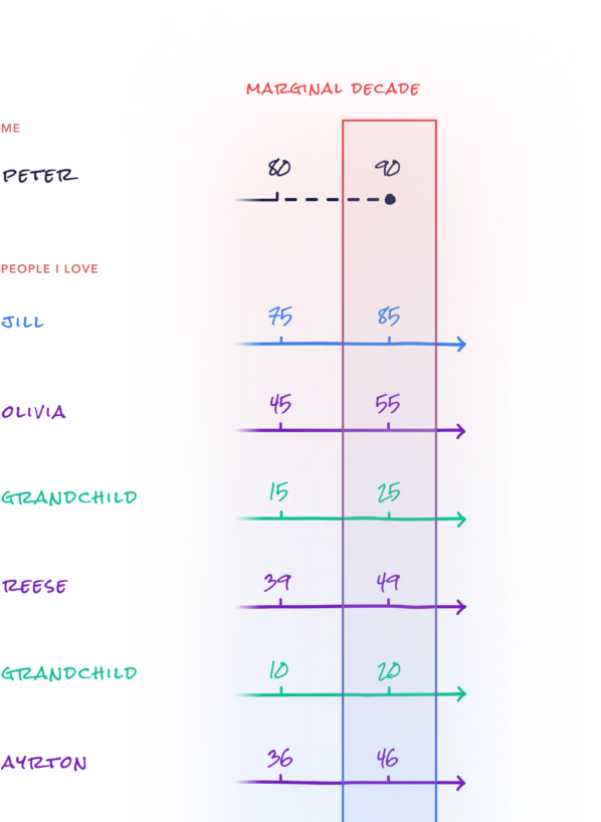
Think back to the relatives you knew between the ages 5 to 15.
How much do you remember about them? What did they miss?
I’ve drawn a version of this exercise on a notecard that I keep in my wallet. I try to look at it every chance I get because it reminds me why I’m doing this work and why I make the sacrifices I do. If you’d like to do something similar, we’ve provided a pocket size version that you can easily fill out and carry around with you. I hope it can help serve the same purpose for you.
Now that you’ve completed the Timeline Exercise, consider what quality of life you need to fully enjoy that final decade of life. Your answer to this questions will come into play in the upcoming modules.