 earlymedical
13.10. Emotional Health Worksheet
Evaluate your current emotional health and how it’s affecting your own life, as well as those around you. Build a plan for a better future.
BUILD YOUR TACTICAL PLAN
Evaluate your current emotional health and how it’s affecting your own life, as well as those around you. Build a plan for a better future.
In this exercise, follow the sheet labeled Emotional Health Worksheet. You should have already downloaded and printed this from the Tactical Plan Worksheet in the Resources section.
RESOURCES
Refer to the Tactical Plan Worksheet
CHALLENGES AND OPPORTUNITIES
Think about someone who you believe lived an excellent life. How much did their lifespan factor into your assessment? Fixation on living longer can sometimes keep us from living well. As discussed in the module, simply living a long life hardly qualifies as a wise goal, and certainly does not if you’re not also living well. Healthspan is what really matters, and emotional health seems to be of particular importance given the fact that it is the only aspect of healthspan that does not inevitably decline with age.
Leveraging our strategy to arrive at a set of tactics is harder here than elsewhere in the program. “How do I live well?” seems a patently harder to answer question than those posed by the other tactics.
OUR APPROACH
-
Help you to break out of autopilot and identify if this is an aspect of your healthspan that you have been ignoring
-
Address Emotional Health as a first-order component in your LRA and correctly identify where it belongs as a risk on your LRA
-
Use the framework we’ve provided as a starting point for building your emotional health plan
STEP ONE: ASSESS
THE BIG PICTURE
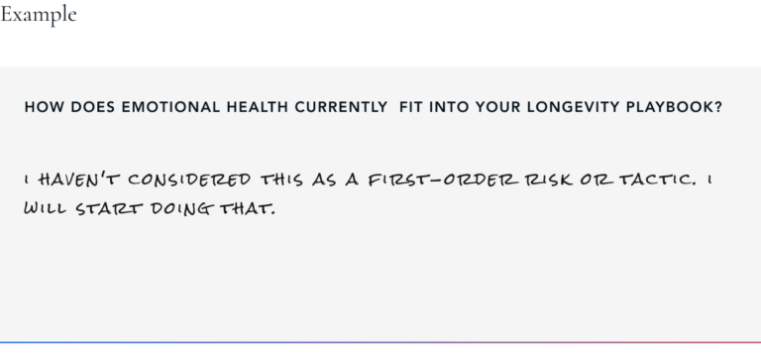
Consider how your emotional health currently fits into your longevity playbook. Then, answer the following questions under Step 1: Assess on the worksheet.
FRAMEWORK ASSESSMENT
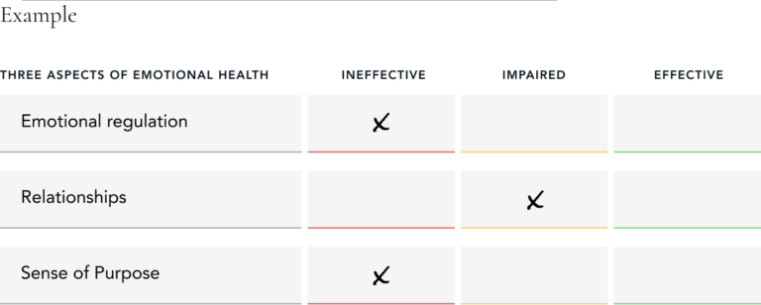
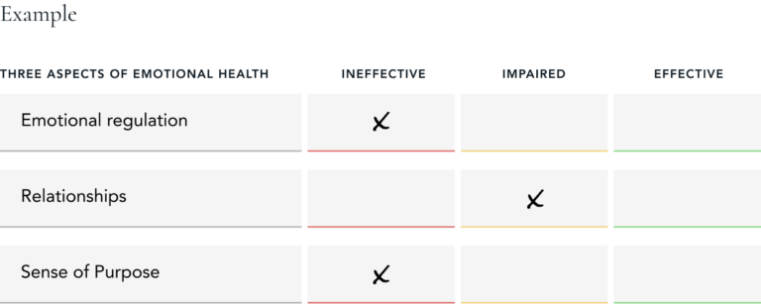
Think back to the three aspects of emotional health from the Module. For each category, mark the column that best describes your current emotional health. The goal for this exercise is to simply identify the areas of your emotional health that need improvement.
Note that doing this as a self-assessment can be quite difficult. Really difficult, actually. You will likely need to draw upon the observations of others, possibly including professionals. In a sense, we’re asking you the emotional equivalent of scratching at scabs to see if anything bleeds. As with similar exercises elsewhere in the program, precision is not the goal here; rather, we’re looking for directional guidance in terms of how you will focus your planning efforts.
When conducting this assessment, do not use a positive or negative valence (e.g., “I’m bad at relationships”). Don’t judge. Just observe.
-
Ineffective – Your performance in this area is actively moving you away from your goals
-
Impaired – Your performance in this area is not helping move you towards your goals
-
Effective – Your performance in this area is actively moving you towards your goals
PRIORITIES ASSESSMENT
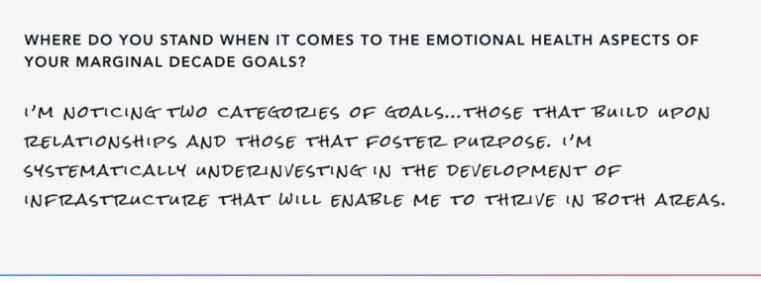
Once again, we’re returning to our Marginal Decade goals. In Modules 9 and 10, we asked you to decompose the physical aspects of your goals in order to make the assessment, “Am I performing at a high enough level today to achieve my goals tomorrow?” Here, we ask that you do the same assessment, but for the non-physical aspects. As things stand today, are you prioritizing the correct aspects to achieve your Marginal Decade goals?
STEP TWO: PLAN
THE BIG PICTURE
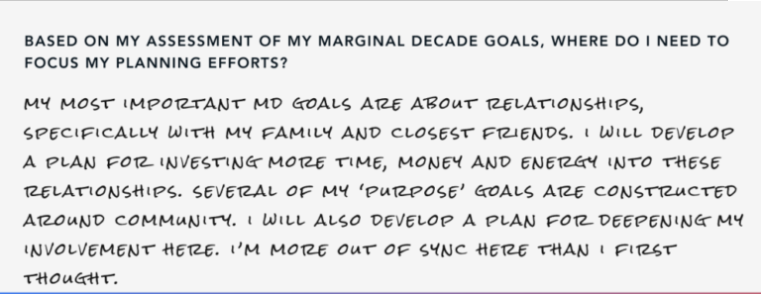
Review your self assessment from Step 1 and answer the questions below under Step 2: Plan on the Worksheet.
FRAMEWORK DRILLDOWN
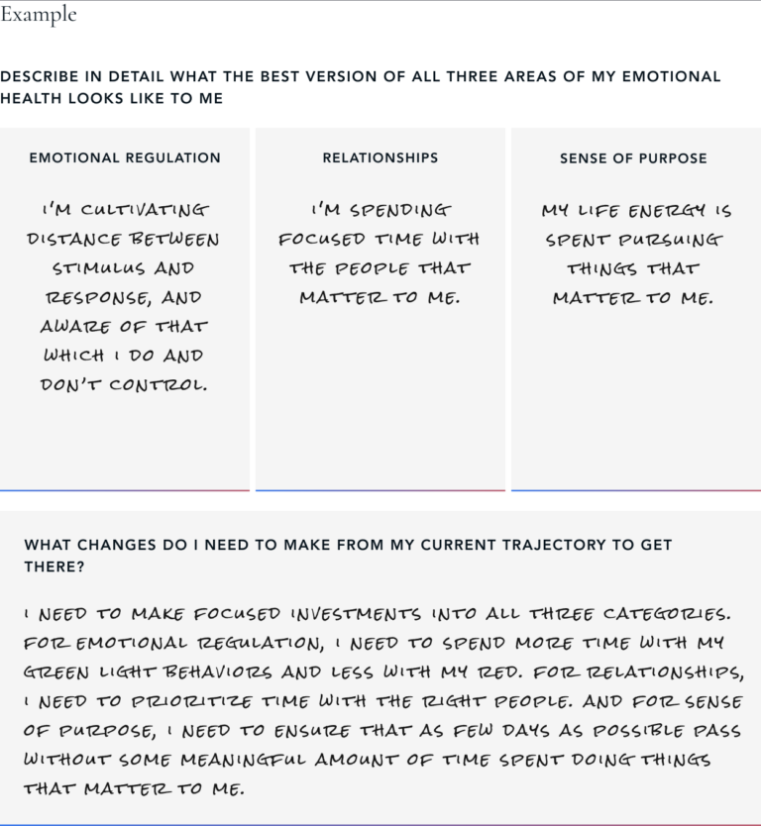
Think about what the best version of all three aspects of your emotional health (emotional regulation, relationships, sense of purpose) looks like to you. Record your answers in the worksheet.
BEHAVIORAL SPOTLIGHT
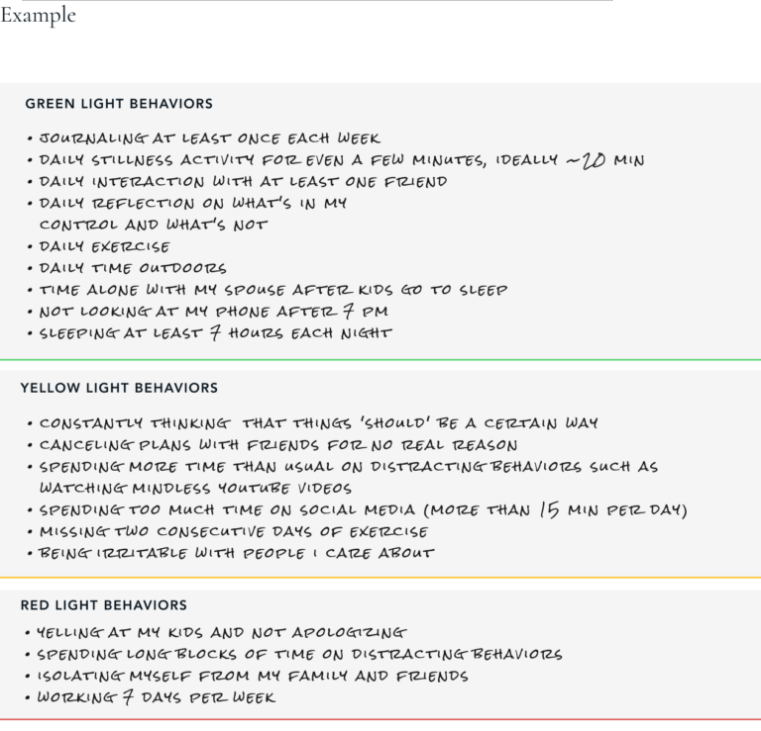
Now, create your own version of the green light, yellow light, and red light behaviors list from the Module.
-
Green light: Behaviors to do every day to widen your window of distress tolerance. These are “self-care” behaviors that make us more able to regulate our emotions.
-
Yellow light: Behaviors that show up before red light behaviors. It’s easy to miss these, as they are often seemingly benign. We want to get better at catching these behaviors before we tumble further into distress so we can take corrective steps.
-
Red light: Behaviors to avoid at all cost. These are behaviors that directly oppose our goals.
As you begin to be more observant of your behaviors, continually ask: what would your best friend tell you about this behavior? Similarly, what would wisemind tell me?
BRING IN THE PROFESSIONALS
Emotional health “training” can be particularly difficult given the challenge of self-assessment and the subtlety of the feedback (am I making progress?). Do you need to enlist the support of a mental health provider to help with your emotional health? If so, the following may help in your search:
-
Recall that our focus here is on mental health not mental illness. As with our other areas of attention, wellness requires focus before illness is present.
-
When evaluating a therapist, ideally after your first encounter, ask:
-
Did this person “get” me?
-
Did I leave the session with something, some insight, I did not know before?
-
Did they challenge me on anything I’ve been thinking (versus just agree with me)?
-
Did we discuss my goals early on?
-
Goals should be clear and tangible, for example, I’m hoping to …
-
Stop procrastinating
-
Not make decisions based on a childhood story
-
Be less anxious
-
Fight less with my spouse.
-
The most important factor in your relationship with your therapist is rapport.
-
A great way to get a referral is from a therapist of a friend who is doing well.
STEP THREE: TRACK
Once again, we’d like for you to find the 80/20 sweet spot in employing these tools. Your goal should be to try to identify correlations between the way you are feeling and the things you are doing. Again, do not lose sight of the forest for the trees. Note how you feel at the end of the day, and then reflect on the things you’ve done during that day.
Schedule time at the end of each week to track the following.
First, going back to the three aspects of emotional health from Lesson 12.2, reflect on the past week and for each category, mark the column that best describes your current emotional health.
-
Ineffective – Your performance here is actively moving you away from your goals
-
Impaired – Your performance here is not helping move you towards your goals
-
Effective – Your performance here is actively moving you towards your goals
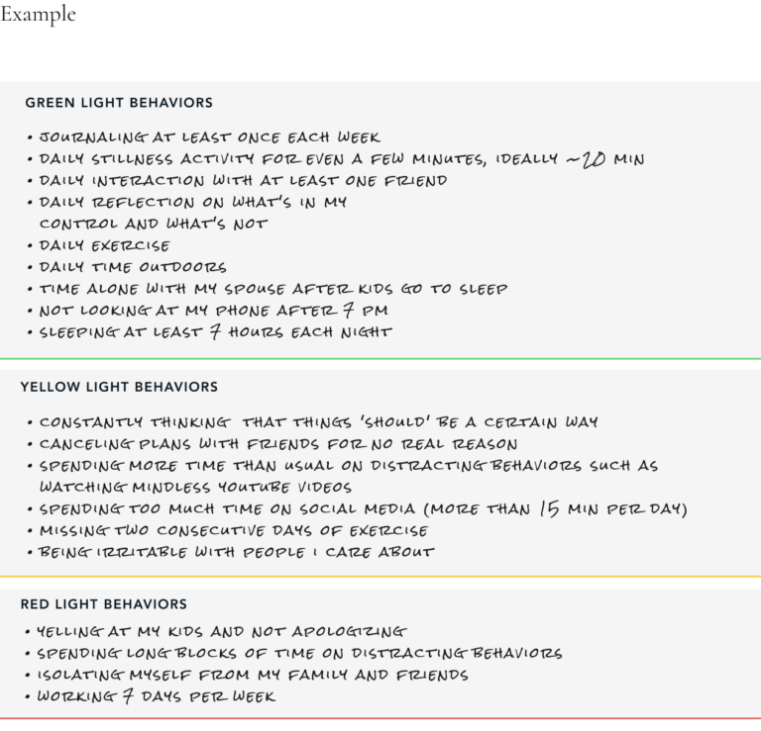
Second, review your behavior for the past week and identify any red, yellow, or green light behaviors.
-
Green light: Behaviors to do every day to widen your window of distress tolerance. These are “self-care” behaviors that make us more able to regulate our emotions.
-
Yellow light: Behaviors that show up before red light behaviors. It’s easy to miss these, as they are often seemingly benign. We want to get better at catching these behaviors before we tumble further into distress so we can take corrective steps.
-
Red light: Behaviors to avoid at all cost. These are behaviors that directly oppose our goals.
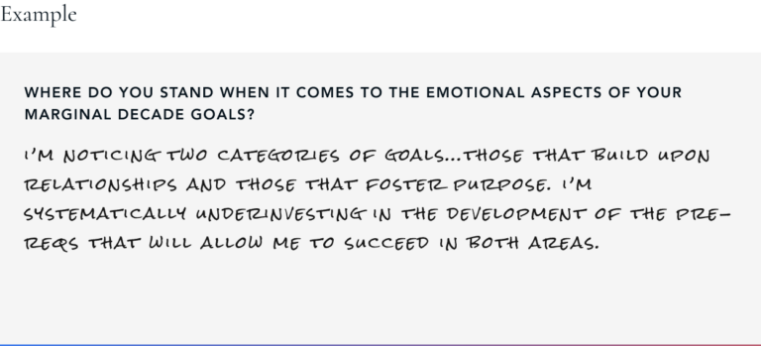
Third, reflect on the emotional health aspects of your Marginal Decade goals. Did you pursue activities that furthered those goals?
Given your evaluation above, what will you aim to do differently next week?
Reflect
Take a moment to reflect on how this new knowledge has impacted your overall emotional health. Answer the following questions under Reflect in the worksheet.
-
Where does emotional health fit on my LRA?
-
What have I found to be the most impactful interventions for my emotional health?
-
What will I do over the next 30 day period to achieve better outcomes?
UPDATE YOUR RESULTS
The key to being early is to take what you’ve learned and apply it consistently. Choose a date and consistent time interval to revisit this exercise. It could be one week, month, or year from now, but set a reminder to download the Emotional Health Worksheet and re-evaluate your emotional regulation, relationships, and sense of purpose.