 earlymedical
9.9. Nutrition Worksheet
BUILD YOUR TACTICAL PLAN
Learn how to assess your metabolic health and create a plan for your nutrition.
In this exercise, follow the sheet labeled Tactic 1: Nutrition. You should have already downloaded and printed this from the Tactical Plan Worksheet in the Resources section.
RESOURCES
STEP ONE – ASSESS
METABOLIC HEALTH
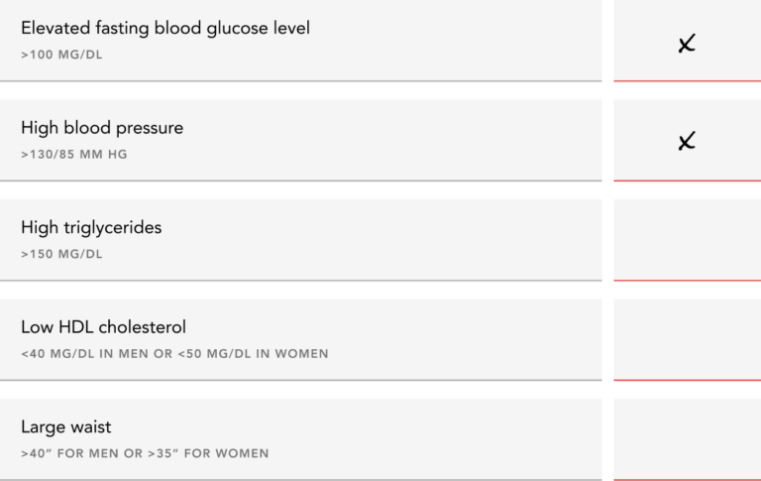
To assess your current metabolic health, determine whether you have any of the five indicators of metabolic syndrome and mark the indicators that are applicable to you.
Example
ASSESSING YOUR METABOLIC HEALTH
Metabolic syndrome, or MetSyn, is a heuristic for metabolic dysregulation, and though it’s reported as discrete (i.e., “yes you have it” or “no you don’t”), metabolic health is anything but binary. Your metabolic health lives on a continuum and going through these 5 clinical findings will give you a good starting point of how you stack up, especially at the extremes (i.e., 0/5 or 5/5).
While the MetSyn criteria are far more reliable than simply looking at something like BMI, other factors such as VAT, ALMI, zone 2 output, HbA1c, etc. also factor into the state of your metabolic union.
NUTRITIONAL PROFILE
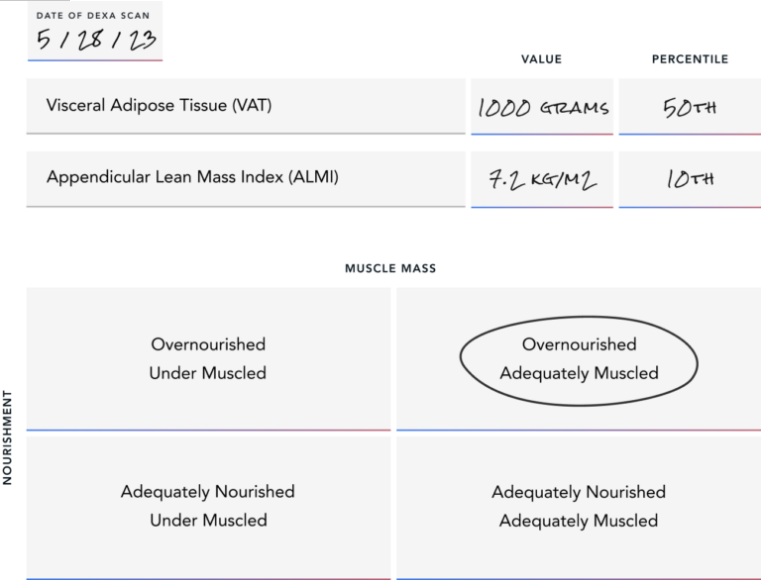
Once you have your DEXA scan results (details in Exercise Module), record your visceral adipose tissue (VAT) and appendicular lean mass index (ALMI) on the worksheet to assess your current nutritional profile. Then, circle the quadrant that describes your VAT and ALMI results.
Interpreting your VAT and ALMI
-
If you are at or above the 75th percentile for your sex and age in ALMI per your DEXA scan, you are likely what we would call adequately muscled.
-
If you are at or above the 10th to the 20th percentile in VAT for your sex and age per your DEXA results, you are likely what we would call overnourished, even if your body fat is “normal.”
-
Total body fat measured by your DEXA scan can also play a part in this. Given the current prevalence of obesity, a total body fat greater than approximately the 35th percentile for your sex and age is likely an indication of over nutrition, especially if paired with VAT above the 20th percentile.
For more information on how to interpret your VAT and ALMI, download the DEXA Scan Analysis PDF from the Exercise Module.
Example
PROTEIN INTAKE
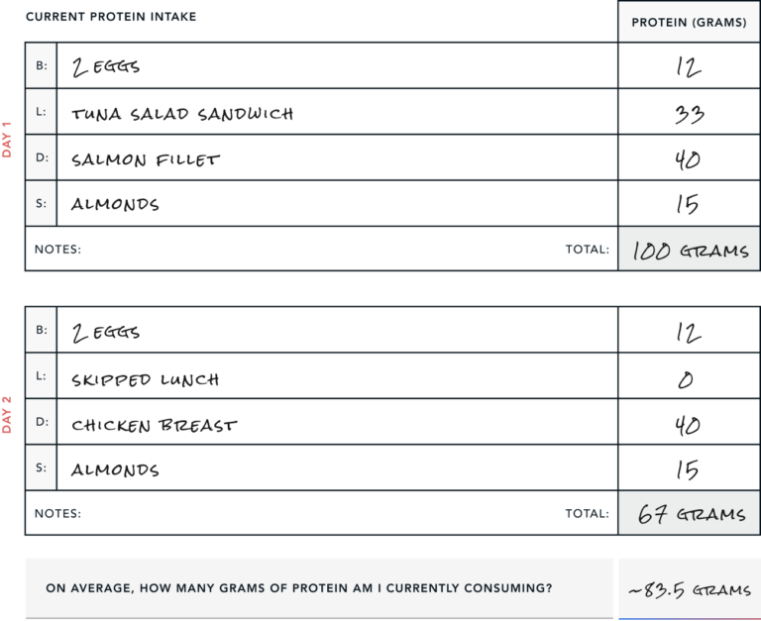
Assess your current protein intake by tracking your normal eating routine (breakfast, lunch, dinner, snack) for two days. Calculate the total average of protein and record it under Step 1: Assess on the worksheet. Use a nutrition tracking app to help with these calculations (recommendations below in Step 3).
Example
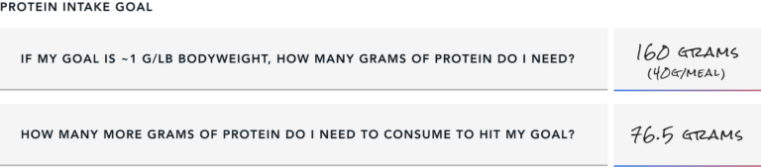
Then, calculate your protein intake goal. We recommend consuming ~0.7 to 1 gram of protein per pound of bodyweight (~1.5-2 grams per kilogram). Factors that will push you to the upper end of this range are age (as we get older, we develop anabolic resistance and need more amino acids to maintain muscle mass), training volume and intensity, and training goals (e.g., maintenance of lean tissue vs adding lean tissue). If you have reduced kidney function, work with your healthcare provider to figure out what a healthy protein intake is for you, as it may be lower than this level.
Example
INTERPRETING YOUR PROTEIN INTAKE
How does your current protein intake compare to your new goal? Are you consuming enough protein? How many more grams of protein do you need to consume to hit that target?
STEP TWO – PLAN
INPUT 1: METABOLIC HEALTH
Review your metabolic health data. Where do you lie on this continuum?
INPUT 2: 2×2 QUADRANT
Review your 2×2 chart from Step 1. Identify the quadrant you are in.
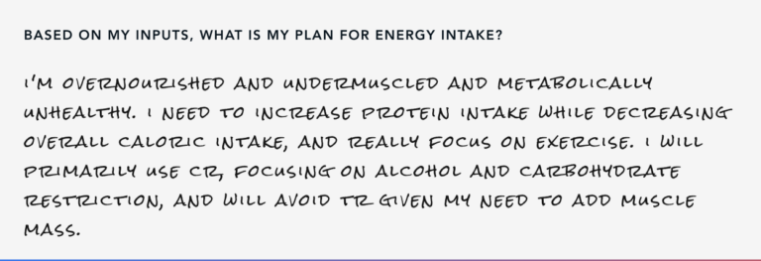
ENERGY INTAKE PLAN
-
Overnourished and Under Muscled + Metabolically Healthy
-
Restrict total calories, without compromising protein targets for muscle growth.
-
Lift weights and do cardio, prioritize strength training.
-
Note: If you are overnourished and under muscled, review the content discussed in the “Fasting” video before implementing time restricted feeding (TR) as your caloric restriction strategy.
-
Overnourished and Under Muscled + Metabolically Unhealthy
-
Restrict total calories, without compromising protein targets for muscle growth
-
Lift weights and do cardio, prioritize both.
-
Note: If you are overnourished and under muscled, review the content discussed in the “Fasting” video before implementing time restricted feeding (TR) as your caloric restriction strategy.
-
Be attentive to sleep and be sure it is optimized.
-
Overnourished and Adequately Muscled + Metabolically Healthy
-
If aesthetics matter, restrict total calories, without compromising protein targets for muscle growth. In this case, it’s okay to be at the lower end of protein intake.
-
Continue lifting, but focus on increasing cardio.
-
Overnourished and Adequately Muscled + Metabolically Unhealthy
-
Very similar to above, but likely a greater emphasis on reducing intake and increasing cardio training.
-
Be attentive to sleep and be sure it is optimized.
-
Adequately (or under) Nourished and Under Muscled + Metabolically Healthy
-
Don’t focus on total calories and instead focus on increasing protein intake. If undernourished, let the calories go up; if adequately nourished, hold calories roughly constant.
-
Increase strength training and consider less cardio, if you are already doing a lot of cardio.
-
Adequately (or under) Nourished and Under Muscled + Metabolically Unhealthy
-
Don’t focus on total calories and instead focus on increasing protein intake. If undernourished, let the calories go up; if adequately nourished, hold calories roughly constant.
-
Increase both strength training and cardio and be sure sleep is optimal.
-
Adequately Nourished and Adequately Muscled + Metabolically Healthy
-
Stay the course
-
Focus on going deeper into your exercise goals and fine tuning your training (e.g., getting more ambitious around your Centenarian Decathlon goals).
-
Adequately Nourished and Adequately Muscled + Metabolically Unhealthy
-
This is not an expected phenotype.
Example
MACRONUTRIENT PLAN
Now that you know the changes you need to implement based on your energy intake, set specific macronutrient targets. What is your plan for ethanol, protein, and carbohydrates consumption?
Example
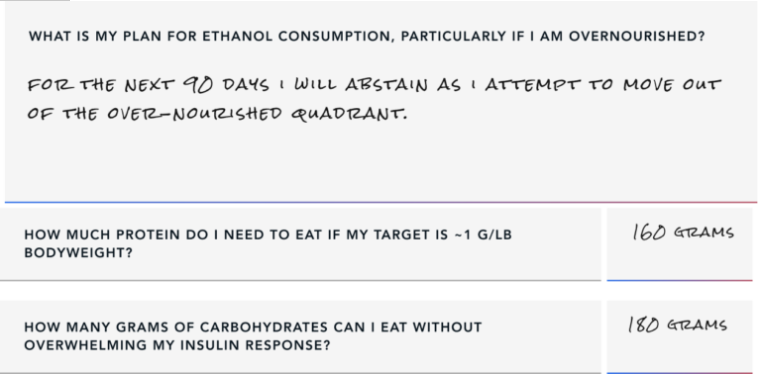
To answer this question, use a continuous glucose monitor (CGM) or other glucose meter to assess against the metrics shared in the videos.
-
Average blood glucose <100 mg/dL
-
Standard deviation <15 mg/dL
-
Minimum number of peaks >140 mg/dL
NUTRITIONAL PLAN
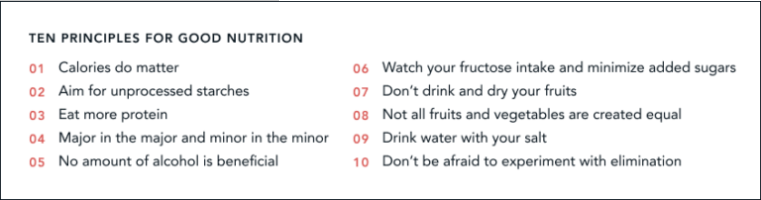
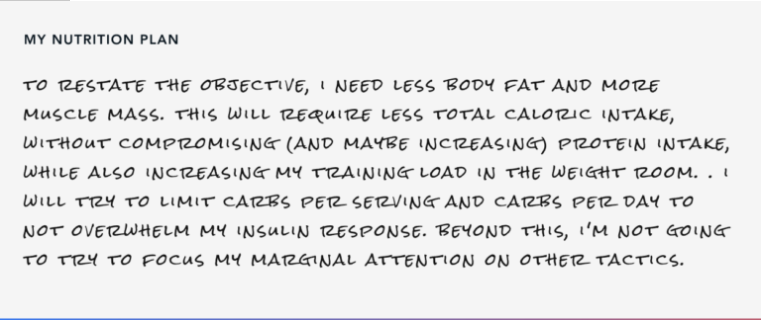
Synthesizing your goals for energy intake and macronutrients, create a nutrition plan in your worksheet. Remember to follow the ten principles for good nutrition.
Example
STEP THREE – TRACK
NUTRITION TRACKING APPS
-
MyFitnessPal
-
Carbon
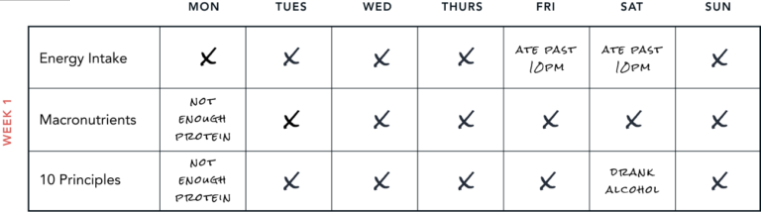
At the end of every day, use the chart under Step 3: Track to mark your energy intake, macronutrients, and principle targets as complete. If there are certain goals or principles that you are struggling to meet, explain why in the appropriate box.
Example
Reflect
Once you’ve recorded 30 days of nutrition, take a moment to reflect on how this new knowledge has impacted your overall health. Answer the following questions under Reflect in the worksheet. Remember, the exercise is half in what you do and half in the process of recording and reviewing it. The goal is to only create a change, but to also be mindful of it and imprint it.
Am I consistently hitting my energy intake, macronutrient, and 10 principle targets?
What will I change based on these insights?
Take a moment to look back on your Longevity Risk Assessment (LRA) from Module 3. What impact does your improved nutrition have on your health risks?
UPDATE YOUR RESULTS
The key to being early is to take what you’ve learned and apply it consistently. Now that you know what good nutrition means to you, choose a date and consistent time interval to revisit this exercise. Set a reminder to download the Nutrition Worksheet and reassess your metabolic health, nutritional profile, and protein intake.